Thursday, April 2, 2020

Why would "stones cry out" on Palm Sunday?


As we prepare to celebrate the triumphal entry of Jesus into Jerusalem, I want to look at a fascinating little verse in the gospel of Luke.

Luke 19:40
Jesus answered, “I tell you, if these were silent, the very stones would cry out.”

What is Jesus talking about?

Let me give you some context. Jesus rides into Jerusalem on a donkey, fulfilling the prophecy of Zechariah 9:9 about how the king will enter the city. The crowd starts cheering, "Blessed is he who comes in the name of the Lord! Peace in heaven and glory in the highest!" They believe that Jesus is the Messiah-King who will rescue God's people and bring peace. But the Pharisees are absolutely opposed to this idea. They find it offensive to imagine this carpenter-teacher as God's chosen Messiah. Therefore, the Pharisees tell Jesus to rebuke his followers and make them be quiet. Jesus responds, "I tell you, if these were silent, the very stones would cry out."

What is Jesus talking about?

There are two ways to understand this verse. On the one hand, the Pharisees might think back to Habakkuk 2 about how God will punish the Babylonians for their greed, wickedness, and violence done against Israel.

Habakkuk 2:9-12
Woe to him who gets evil gain for his house, to set his nest on high, to be safe from the reach of harm! You have devised shame for your house by cutting off many peoples; you have forfeited your life. For the stone will cry out from the wall, and the beam from the woodwork respond. Woe to him who builds a town with blood and founds a city on iniquity!

With this interpretation, Jesus is declaring that if people reject his kingship, God will send judgment, which is exactly what Jesus says later on in the passage.

Luke 19:43-44
For the days will come upon you, when your enemies will set up a barricade around you and surround you and hem you in on every side and tear you down to the ground, you and your children within you. And they will not leave one stone upon another in you, because you did not know the time of your visitation.

On the other hand, the Pharisees could reflect on passages of Scripture about creation singing praises to God for his work of salvation.

Psalm 96:11-13
Let the heavens be glad, and let the earth rejoice; let the sea roar, and all that fills it; let the field exult, and everything in it! Then shall all the trees of the forest sing for joy before the LORD, for he comes, for he comes to judge the earth. He will judge the world in righteousness, and the peoples in his faithfulness.

Isaiah 44:23
Sing, O heavens, for the LORD has done it; shout, O depths of the earth; break forth into singing, O mountains, O forest, and every tree in it! For the LORD has redeemed Jacob, and will be glorified in Israel.

Isaiah 55:12
For you shall go out in joy and be led forth in peace; the mountains and the hills before you shall break forth into singing, and all the trees of the field shall clap their hands.

All of creation rejoices in the Lord for his magnificent work of redemption. In the triumphal entry, Jesus is on his way to fulfill God's plan of redemption. Jesus is the Messiah-King who will rescue God's people from sin and establish God's kingdom. He deserves to be acknowledged and celebrated for who he is. If the followers of Jesus are silent, then God can cause the stones to cry out in praise and worship.

So here's the point: Jesus is the King and the Savior. He is worthy of all praise and worship. Let's raise our hearts and voices and join the song that we will be singing for all eternity, "Worthy is the Lamb who was slain, to receive power and wealth and wisdom and might and honor and glory and blessing! To him who sits on the throne and to the Lamb be blessing and honor and glory and might forever and ever!" (Revelation 5:12-13)


Wednesday, April 1, 2020

Shine the light of 2 Corinthians

The view of Lake Victoria out our back gate in Tanzania.
Praise the Lord! We finished the final check of 2 Corinthians in the Jita language. Now the Jita people can enjoy the beauty of the gospel in 2 Corinthians 4:6,
Okubha Nyamuwanga ꞉aayikire ati, “Obhweru bhumurike mu‑chisuute.” Omwene niwe kaamirika emyoyo jeeswe, na okuchiyaana obhweru bhwa okusombookerwa rikusyo ryaye, rinu eringʼarabhya mu‑bhusu bhwa Yeesu Kirisito. 
For God, who said, “Let light shine out of darkness,” has shone in our hearts to give the light of the knowledge of the glory of God in the face of Jesus Christ.

Pray that the Jita people will hear the gospel and believe in Jesus and enter his marvelous light.

Friday, March 27, 2020

Coronavirus can't stop Corinthians


Even though we are bound to our houses, God's Word is not bound! We are continuing to translate the Bible into the Jita language. I've been checking the first draft of 1 Corinthians. 1 Corinthians 1:23 says, "but we preach Christ crucified, a stumbling block to Jews and folly to Gentiles." Is Paul using the word "stumbling block" in the same sense as in Romans 9:33 or in Romans 14:13? What is the best way to communicate that meaning in Jita?

We are also doing the final check on 2 Corinthians. We discussed 2:17, "For we are not, like so many, peddlers of God’s word." What does it mean to be a peddler of God's Word? In Tanzania (and in America!), many preachers twist God's Word in order to manipulate people into giving them money. Some preachers will sell "holy water," or "sacred oils," or even "anointed pens" for ridiculously high prices. One preacher refused to start preaching until people in the congregation gave him enough money to buy a new smart phone. Clearly, this idea of peddling God's Word is well-known in Tanzania. After lots of discussion, we made sure that the Jita translation is accurate, clear, and natural. 

Please keep praying for the Jita translators: Magesa and Neema. Pray that God will protect them and their families. And please keep praying for us. I cannot be back to working full-time on the translation until we get back to 100% of our ministry budget. We realize that this is a difficult time for everyone, but with all of the fear and uncertainty, it is even more important that people have God's Word in their own language. If you would like to join our team as a prayer and financial partner, go to our Wycliffe ministry page here:  
Thank you!!

Saturday, March 21, 2020

Corona means crown, but it's not the king


Kara wrote this for a school assignment. It's beautiful! She discovered that corona means crown in Latin and her assignment was about how Christians should think about the coronavirus and how we can encourage others who are struggling with anxiety and fear.
For you did not receive the spirit of slavery to fall back into fear, but you have received the Spirit of adoption as sons, by whom we cry, “Abba! Father!” (Romans 8:15)
After reading Romans 8:15, I am encouraged once again that I have no reason to fear! We have received the Spirit by whom we cry, “Daddy!” God is our heavenly father, and he knows what is going on. He is sovereign, even over coronavirus. He hears us when we cry for help. When I begin to fear again about the coronavirus, I can remember Jesus’ “corona” of thorns. Jesus suffered greater tribulation than we will ever face. Even if we do get the corona of death, in heaven Jesus will give us the “corona” of life! We know that we will see King Jesus face-to-face, and he will have a “corona” on his head.


Thursday, March 19, 2020

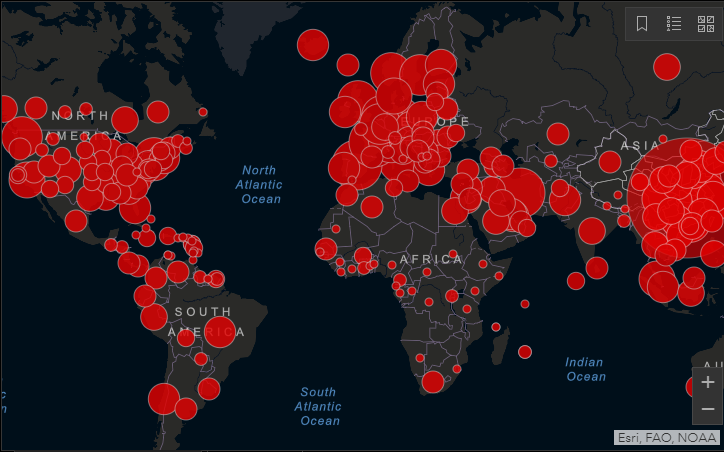
How the pandemic map reminds me of the gospel


As I watch the news reports of COVID-19 spreading to the ends of the earth, I need to remind myself of the massive hope that we have in Jesus. Our hope is that Jesus will return to earth as king to make everything new, and we will live with him forever. "He will wipe away every tear from their eyes, and death shall be no more, neither shall there be mourning, nor crying, nor pain anymore, for the former things have passed away" (Revelation 21:4). We long for the day when COVID-19 and every other disease will be completely eradicated. On that day, "The earth shall be full of the knowledge of the LORD as the waters cover the sea" (Isaiah 11:9). Our hearts will overflow with joy because we will see the resurrected, exalted Jesus in all of his majesty and power. With thankful hearts we will all sing, "Blessed be the LORD, the God of Israel, who alone does wondrous things. Blessed be his glorious name forever; may the whole earth be filled with his glory! Amen and Amen!" (Psalm 72:18-19).

But until that glorious return of Jesus, we have a mission to spread the good news of his kingdom to the end of the earth. In the Old Testament, God promised to send the Messiah, "as a light for the nations, that my salvation may reach to the end of the earth" (Isaiah 49:6). Then in the New Testament, the followers of Jesus are called "the light of the world" (Matthew 5:14), and they are commanded to be his "witnesses in Jerusalem and in all Judea and Samaria, and to the end of the earth" (Acts 1:8). We have the joyful task of shining the light of Jesus by proclaiming the good news of repentance and salvation and eternal life. The message is simple, "Turn to me and be saved, all the ends of the earth! For I am God, and there is no other" (Isaiah 45:22). Our passion is to see people all over the world believing in Jesus until, "All the ends of the earth shall remember and turn to the LORD, and all the families of the nations shall worship before you" (Psalm 22:27). This is our hope and joy and passion! Even in the midst of a pandemic. Let's pray that God will use this crisis to draw people to himself. Let's use this opportunity to shine the light of the gospel through good works and good news until, "All the ends of the earth have seen the salvation of our God" (Psalm 98:3). 


Tuesday, March 10, 2020

67% and new momentum


This is very exciting! Look at how God is providing! He has brought some new ministry partners onto our team, and he has stirred the hearts of some long-time partners to increase their support. We appreciate each and every one of you.

If you would like to join our team as a prayer and financial partner, check out our Wycliffe website here:
www.wycliffe.org/partner/2EBEFB


Thursday, March 5, 2020

Is it the Dead Sea or the Salt Sea?


We're in the final stages of preparing the book of Matthew for publication in the Jita language! Now we're working on the map. The translators said that a map would really help our readers to understand the context of the book. I certainly agree. First, we had to choose a map template. Our only templates are for the entire New Testament so they list EVERY location mentioned in the gospels. We only want the locations specifically mentioned in Matthew. Therefore, I had to go through the whole book of Matthew and list out all of the places, and then go through the Jita translation to find their corresponding Jita spellings.

When that was finished, we then had to decide how we want to label the Dead Sea and the Mediterranean Sea. Neither of them are mentioned in the book of Matthew, but we thought it might be helpful as points of reference. The Mediterranean Sea is called "The Great Sea" or "The Western Sea" in the Old Testament and the Dead Sea is called "The Salt Sea" or "The Eastern Sea." Which names should we use? We ended up choosing the more common names for the sake of our readers.